
C
ClearView News

Is CW Morse code?

Author

Emily Cortez

Published Mar 03, 2026

Is CW Morse code?

Sometimes the abbreviation CW is used to denote a Morse transmissions. Essentially CW refers to a Morse transmission using a radio signal - the abbreviation coming from the fact that it uses a Carrier Wave, or Continuous Wave that is interrupted.

Accordingly, what is CW communication?

CW stands for Continuous Wave. In CW communications, a continuous carrier is transmitted as long as the key contacts are closed. By making and breaking the contacts into specific patterns, characters and entire messages may be sent.

Likewise, is Morse code universal? Morse Code The Universal Language. Morse code the universal language. Well, I discovered that Morse code as we amateur radio operators know it is based on the English language, using the 26 letters, the ten simple numbers, and some punctuation marks. And wow it is accepted as the universal language for this use.

Then, does anyone still use Morse code?

Morse Code is still widely recognized, even if it is not as widely used as it once was. Morse code is still popular among amateur radio enthusiasts, although proficiency in Morse Code is no longer a requirement to obtain your amateur radio license.

What does CW stand for Morse code?

Sometimes the abbreviation CW is used to denote a Morse transmissions. Essentially CW refers to a Morse transmission using a radio signal - the abbreviation coming from the fact that it uses a Carrier Wave, or Continuous Wave that is interrupted.

Why is Morse code called CW?

International Morse code today is most popular among amateur radio operators, in the mode commonly referred to as "continuous wave" or "CW". (This name was chosen to distinguish it from the damped wave emissions from spark transmitters, not because the transmission is continuous.)

What is CW modulation?

ECE 405. Continuous Wave Modulation. A modulation is a process of transforming a baseband signal (message) to another signal called modulated waveform. The demodulation is the process of recovering the baseband signal. from the modulated waveform.

What is CW testing?

CW testing is Continuous Wave Testing. CW testing is the First Phase of Telecom/Mobile Network/Radio Frequency (RF) Planning. It is carried out to gather actual propagation of mobile signals in different terrain and clutter.

What is CW laser?

A CW laser is a laser that emits a continuous laser beam with a controlled heat output, as beam duration and intensity. It's important to note that we are an OEM (original equipment manufacturer) of CW fiber lasers.

What is SSB radio?

In radio communications, single-sideband modulation (SSB) or single-sideband suppressed-carrier modulation (SSB-SC) is a type of modulation used to transmit information, such as an audio signal, by radio waves. A refinement of amplitude modulation, it uses transmitter power and bandwidth more efficiently.

Is CW a digital mode?

And both modes are defined by their method of modulation. Since CW is modulated by on/off keying, the MODE CW is digital. Since FM is usually modulated by analog voice, the mode FM is usually considered analog. CW is MORE digital than FM is analog because CW is ALWAYS considered an on/off mode

What is I love you in Morse code?

Originally Answered: How would you say I love you in Morse code? Craig Moody, An avid Morse code buff and a Ham Radio operator. If you were to actually say it in Morse code, using speech, you would say, "Di-dit, di-dah-di-dit dah-dah-dah di-di-di-dah dit, dah-di-dah-dah dah-dah-dah di-di-dah.

What replaced Morse code?

The Morse system will be replaced by a satellite link called the Global Maritime Distress and Safety System.

What is SOS in Morse code?

In the language of Morse code, the letter ā€œSā€ is three short dots and the letter ā€œOā€ is three longer dashes. Put them together and you have S.O.S. These sounds represent the international call for help because they are easy to recognize. Now, it is simply known as S.O.S.

Where is Morse code used today?

Today, American Morse code is nearly extinct. A few amateur radio users and Civil War re-enactors still keep it alive. Morse code became extremely important in maritime shipping and aviation. Pilots were required to know how to communicate using Morse code up until the 1990s.

How do you speak in Morse code?

Sound out each signal.
Dits make a short, single-syllable sound. Dahs are more drawn out, and should last approximately three times as long as dits when pronounced. This fast and slow rhythm is how individual units are distinguished in Morse Code. Pay attention to the spacing between words and letters.

Is Morse code dead?

In 2003, the international requirement for proficiency in Morse code was dropped, and many hams (like myself) are no longer able to use it. However there remain large numbers of hams around the world who still choose to use 'CW', and there is no sign of that dying out for a good while yet.

Is Morse code a language?

No but it is a way of coding the individual letters of many different languages into sound bits and bytes that we can understand. Please don't refer to Morse code as dots and dashes. It should be dits and dahs as it is meant to be listened to, never written down.

How do you learn Morse code by tapping?

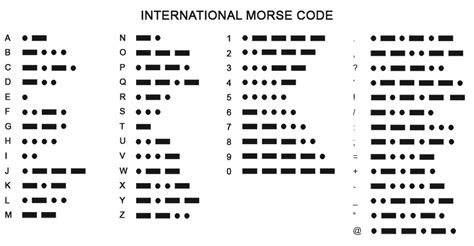
For example, instead of writing the letter e, you make one short signal (one quick flash of light, one quick tap). You write the Morse signals with the dots and dashes on the right. When you signal with Morse, a dash should last three times as long as a dot. Combinations of signals make words, just as letters do.

Is binary a Morse code?

Morse code is said to be a binary (literally meaning two by two) code because the components of the code consists of only two things - a dot and a dash. Strictly speaking it is not binary, as there are five fundamental elements (see quinary).

Is Morse code easy to learn?

While learning Morse Code isn't particularly difficult, it does require study and dedication like any other language. Once you've learned the meaning of the basic signals, you can begin writing and translating messages of your own.

Is Morse code only in English?

No. Morse code encodes the letters of the English language. It doesn't encode words. If you want to use it for other languages you will have to map the alphabet, for European languages, that is languages using the Latin alphabet, this is usually done by simply dropping all diacritical marks.

WHAT IS A in Morse code?

Morse code is a method used in telecommunication to encode text characters as standardized sequences of two different signal durations, called dots and dashes or dits and dahs. Morse code is named for Samuel Morse, an inventor of the telegraph. The duration of a dash is three times the duration of a dot.

How long does it take to learn Morse code?

Originally Answered: How long would it take you to learn morse code if you had 20 minutes per day ? From experience, it should only take you a month or two to learn how to copy Morse at 10 wpm.

How many types of Morse code are there?

There are different types of Morse code for some different countries. There are three different symbols in Morse code; there's a short one, usually called 'dit', a long one, called 'dah', and the pause.

How old is Morse code?

Developed in the 1830s and 1840s by Samuel Morse (1791-1872) and other inventors, the telegraph revolutionized long-distance communication. It worked by transmitting electrical signals over a wire laid between stations.

What does dah dit mean?

Morse code is often spoken or written with "dah" for dashes, "dit" for dots located at the end of a character, and "di" for dots located at the beginning or internally within the character.

What is Farnsworth speed?

Farnsworth tim- ing is defined as sending the characters at a faster speed than the words. For example, sending the characters at 20 WPM but adding enough time between them to slow down the rate to 10 WPM. For example, a 5-WPM transmission sent with 18-WPM characters is specified as 5/18 speed.

Is Morse code required for ham license?

Morse code is no longer required for earning an amateur radio license in the U.S. In a statement, the FCC joined an international trend by announcing the elimination of testing for proficiency in Morse code for all amateur radio license classes.