
C
ClearView News

How do you cite a work reference?

Author

Charlotte Adams

Published Feb 22, 2026

How do you cite a work reference?

Your in-text citation should include both authors: the author(s) of the original source and the author(s) of the secondary source. For example: (Habermehl, 1985, as cited in Kersten, 1987). In your reference list you should provide the details of the secondary source (the source you read).

In this regard, how do you cite a reference entry?

Cite an entry in a reference work the way you would cite any source: follow the MLA format template. If the entry is signed, begin with the author's name. If it is unsigned, begin by listing the entry as the title: Botterill, Steven N.

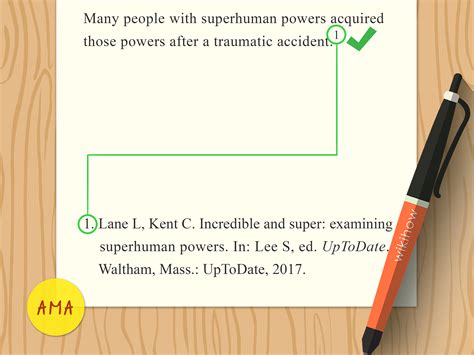
Beside above, how do you cite a quote that is already referenced? Use the words 'cited in' in the in-text citation to indicate you have not read the original research. In the list of references, record the publication you actually sourced. References: Reference the work of the author who has done the citing.

Similarly one may ask, how do you reference your work?

Your work should be both referenced in the text and include a reference list or bibliography at the end, the in text reference is an abbreviated version of the full reference in your reference list.

Do all references need to be cited in text?

The APA Publication Manual (6th ed.) says, "Each reference cited in text must appear in the reference list, and each entry in the reference list must be cited in text" (p. 174). Keep those extra sources in mind for your next paper, and remember: Cite what you use, use what you cite.

How does APA citation look like?

The APA reference page is a separate page at the end of your paper where all sources you cited in the main text are listed. The references are sorted alphabetically, double spaced, and formatted using a hanging indent of ½ inch.

What does reference entry mean?

Elements of Reference List Entries. Reference list entries include the four elements of the author, date, title, and source. the date element, including the format of the date and how to include retrieval dates. the title element, including the format of the title and how to include bracketed descriptions.

How should a reference list look?

What to Include on a Reference List
  1. Your name at the top of the page.
  2. List your references, including their name, job title, company, and contact information, with a space in between each reference.
  3. Include at least three professional references who can attest to your ability to perform the job you are applying for.

How do you format a reference list?

References begin on a separate page from the last page of your writing. Put the word "References" at the top center of the page. Your reference list is alphabetized according to the first word of each end reference. The reference list is double spaced and formatted using a hanging indent.

How do you list references in APA?

The reference list is the last page of your paper. References begin on a separate page from the last page of your writing. Put the word "References" at the top center of the page. Your reference list is alphabetized according to the first word of each end reference.

What does a reference page look like for a resume?

Before you begin your job hunt, gather your references onto a “Professional Reference Page. “ Include each reference's name, title, organization, phone number, and email address. List your references starting with your most impressive or important reference.

Why should you reference your work?

Referencing allows you to acknowledge the contribution of other writers and researchers in your work. Any university assignments that draw on the ideas, words or research of other writers must contain citations. Referencing is a way to provide evidence to support the assertions and claims in your own assignments.

How do you reference in an essay example?

When citing the reference, include the author's name and the page number you pulled the information from in parenthesis, like “(Richards 456).” Once you've finished your essay, add a Words Cited page with all of the information you used to research your essay, like books or articles.

How do you write a reference example?

Conference proceeding: individual paper
  1. Author.
  2. Title of conference paper followed by, In:
  3. Editor/Organisation (if it is an editor always put (ed.) after the name)
  4. Title (this should be in italics)
  5. Place of publication.
  6. Publisher.
  7. Year of publication.
  8. Page numbers (use 'p' before single and multiple page numbers)

What is a reference in an assignment?

You identify sources by citing them in the text of your assignment (called citations or in-text citations) and referencing them at the end of your assignment (called the reference list or end-text citations).

How do you reference your own diagram?

If you use graphs, diagrams, photographs or other images in your work that you have created yourself, you do not need to reference them, but you do still need to give them a caption and explain why they are there. Give your Figure a number (in italics) and title to describe it.

What are the reasons for referencing?

There are three main reasons why it is essential to reference the sources you have used:
  • Acknowledgement. To acknowledge an intellectual debt to another author and to avoid plagiarism.
  • Support. To give supporting evidence to specific facts or claims you make in the text.
  • Referral.

How do you reference a website example?

The basics of a Reference List entry for a Web page or Web document:
  1. Author or authors. The surname is followed by first initials.
  2. Year.
  3. Title (in italics).
  4. Publisher. Where there is a corporate author, the publisher and author may be the same.
  5. Date viewed.
  6. Web address <in angled brackets>.

How do you cite a quote from a person in APA?

For every in-text citation in your paper, there must be a corresponding entry in your reference list. APA in-text citation style uses the author's last name and the year of publication, for example: (Field, 2005). For direct quotations, include the page number as well, for example: (Field, 2005, p. 14).

How do you cite what someone said?

When making reference to the spoken words of someone other than the author recorded in a text, cite the name of the person and the name of the author, date and page reference of the work in which the quote or reference appears.

How do you reference a citation Harvard?

Harvard style referencing is an author/date method. Sources are cited within the body of your assignment by giving the name of the author(s) followed by the date of publication. All other details about the publication are given in the list of references or bibliography at the end.

How do you cite a quote from a person in an article?

Works Quoted in Another Source
  1. Sometimes an author of a book, article or website will mention another person's work by using a quotation or paraphrased idea from that source.
  2. The basic rule is that in both your References list and in-text citation you will still cite Kirkey.
  3. You will add the words “qtd.
  4. According to a study by Smith (qtd.

How do you cite a previously written paper?

Bottom Line: When citing yourself, in whichever style you are utilizing, cite in-text citations to identify yourself as the author. On your Works Cited Page (MLA) or Reference List (APA), identify yourself as the author using the format for an unpublished paper (or published, if you have published it!)

What is the difference between a citation and a reference?

A citation tells the readers where the information came from. In your writing, you cite or refer to the source of information. A reference gives the readers details about the source so that they have a good understanding of what kind of source it is and could find the source themselves if necessary.

Is a citation the same as a reference?

Citations or in-text citations are similar to references, but occur in the body of the text with direct quotes and paraphrases to identify the author/publication for the material you have used. Citations are used: To show which reference supports a particular statement.

When should you not cite?

Don't cite when you are stating common knowledge.
Examples of information that would not need to be cited include: The Declaration of Independence was signed in 1776. Barack Obama became the 44th president of the United States in January, 2009.

Do you have to cite a summary?

You do not need to use quotation marks. Always use in-text citations when you paraphrase or summarize, to let the reader know that the information comes from another source.

What happens if you don't cite sources?

Failure to cite basically means that you are claiming that the entire paper and all of its information as yours and, if that's untrue, it's plagiarism. For example, if you use a passage and don't quote it, it doesn't matter if you cite the source, because you only gave credit for the information, not the words.

Do you have to cite information you already know?

The purpose of citation is to acknowledge the source of your information and ideas, to avoid plagiarism, and to allow the reader verify your claims. You do not need to cite common knowledge because it is widely known, undisputed and easily verified, and it generally cannot be attributed to a specific person or paper.

Do I have to cite my own work?

If you cite or quote your previous work, treat yourself as the author and your own previous course work as an unpublished paper, as shown in the APA publication manual. If your original work contained citations from other sources, you will need to include those same citations in the new work as well, per APA.

What can you reference?

The ideas you reference may come from books, journal articles, newspaper reports, web pages, videos, lecture notes, module teaching materials or any other source. You need to include certain details about these sources in your work so that your reader can find the original material easily.

What do you not need to cite?

You do NOT need to cite: your own words, ideas and original research.

What you don't need to cite

  1. facts that are found in many sources (ex: Marie Antoinette was guillotined in 1793.)
  2. things that are easily observed (ex: Many people talk on cellphones while driving.)
  3. common sayings (ex: Every man has his price.)